
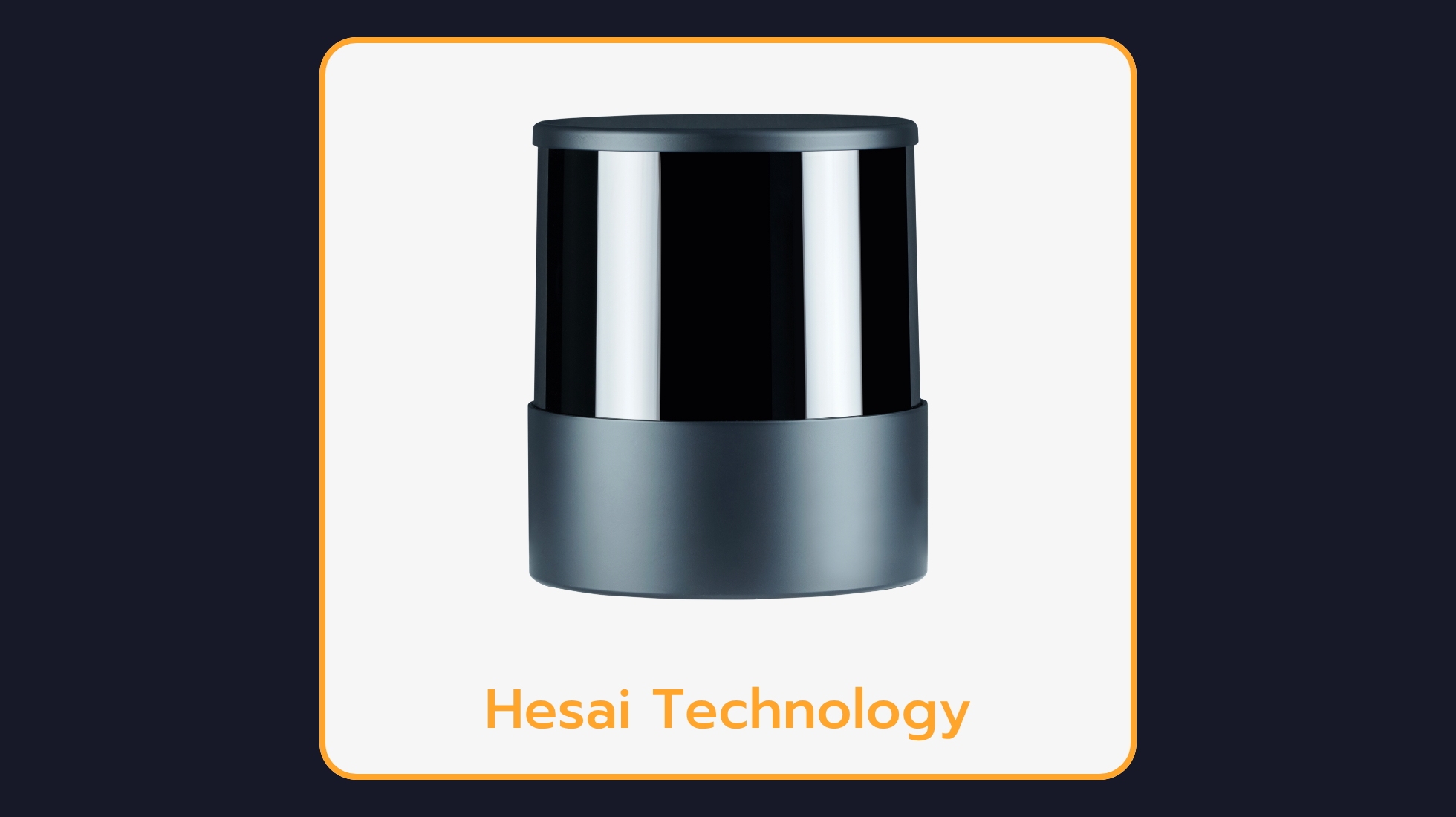
Hesai Technology OT128 Auto-Grade 360° x 40° Long-Range Lidar
Auto-Grade Flagship 360° High-Performance Long-Range Lidar
Hesai's OT128 is a cutting-edge 128-channel mechanical lidar sensor designed for high-performance 3D perception in autonomous vehicles, robotics, smart infrastructure, and industrial systems. With a full 360° horizontal field of view and an extended vertical FOV of 40°, it delivers up to 6.91 million points per second in dual-return mode. OT128 offers configurable horizontal resolution (0.1°–0.4°), ±3 cm ranging accuracy, and a maximum range of 230 meters. Engineered for reliability in harsh conditions, it features IP6K7/IP6K9K protection, operates from –40°C to 75°C, and supports advanced synchronization via PTP. OT128 is ideal for applications requiring dense point clouds, wide-angle coverage, and robust data quality under demanding conditions.
OT128 Auto-Grade 360° x 40° Long-Range Lidar Technical Specifications
Range | 0.3 to 230 m 1 to 200 m (at 10% reflectivity) |
Number of channels | 128 |
Detection Range Accuracy | ±3 cm (3 to 200 m, typical) |
Horizontal FOV | 360° |
Horizontal resolution | Configurable on-the-fly 0.1°/0.2° (10 Hz) 0.2°/0.4° (20 Hz) |
Vertical FOV | 40° (–25° to +15°) |
Vertical resolution | 0.125° (Channel 24 to 89) 0.36° (Channels 8 to 24, 89 to 121) 0.67° (Channels 4 to 8, 121 to 125) 1.2° to 1.72° (Channels 1 to 4, 125 to 128) |
Frame rate | 10 Hz, 20 Hz |
Mechanical/Electrical | |
Power | 29 W |
Operating Voltage | DC 9 to 32 V |
Dimensions | Height: 132.3 mm Top/bottom: Φ111.4/116.0 mm or Φ111.4/118.0 |
Weight | 2.2 kg |
Why Choose the OT128 Auto-Grade 360° x 40° Long-Range Lidar?
A single OT128 lidar can cover a vehicle’s entire field of view without stitching.
With a finest angular resolution of 0.1° (H) x 0.125° (V), the OT128 can accurately perceive objects large and small at a distance of 200 meters away, providing powerful perception data for autonomous driving systems.
Under 100 klux strong ambient light, OT128 has a ranging capability of 200 m at 10% reflectivity (230 m maximum), clearly detecting objects in real time and capturing every detail of its surrounding road conditions.
IPE: Noise Filter Functio
What Is the OT128 Auto-Grade 360° x 40° Long-Range Lidar Used For?
Typical applications of the OT128 Auto-Grade 360° x 40° Long-Range Lidar include:
Autonomous vehicles, robotaxis and shuttle perception systems
ADAS development, validation and data collection vehicles
Mobile robotics, AGVs, AMRs and delivery robots
Smart infrastructure, V2X and roadside perception units
HD mapping, surveying and digital-twin data acquisition
Frequently Asked Questions
What is the OT128 Auto-Grade 360° x 40° Long-Range Lidar?
Hesai's OT128 is a cutting-edge 128-channel mechanical lidar sensor designed for high-performance 3D perception in autonomous vehicles, robotics, smart infrastructure, and industrial systems. With a full 360° horizontal field of view and an extended vertical FOV of 40°, it delivers up to 6.91 million points per second in dual-return mode.
Is the OT128 Auto-Grade 360° x 40° Long-Range Lidar suitable for autonomous vehicle projects?
Yes. The OT128 Auto-Grade 360° x 40° Long-Range Lidar produces real-time 3D point cloud data used for object detection, obstacle avoidance and localization in autonomous driving and robotics stacks, and it integrates with common perception frameworks such as ROS-based pipelines and Autoware.
Where is the OT128 Auto-Grade 360° x 40° Long-Range Lidar available?
The OT128 Auto-Grade 360° x 40° Long-Range Lidar is available through Leo Drive in the following region: Turkey. For other regions, please contact Leo Drive.
How can I get the datasheet and technical documents for the OT128 Auto-Grade 360° x 40° Long-Range Lidar?
Please contact Leo Drive to request the datasheet, user manual and other technical documents for the OT128 Auto-Grade 360° x 40° Long-Range Lidar.
Explore More at Leo Drive
The OT128 Auto-Grade 360° x 40° Long-Range Lidar is part of the Lidar Sensors range at Leo Drive. Browse all autonomous vehicle sensors and components, or talk to our engineering team about integration in your project.
